

Digital kitchen scales

Digital Kitchen Scales: The Small Tool That Can Make Cooking So Much Easier

Have you ever followed a recipe exactly—or at least thought you did—only to end up wondering why the result wasn’t quite right? Maybe the bread was too dense, the cake was a little dry, or that carefully planned portion somehow became much larger than expected. Sometimes the problem isn’t your cooking. It’s the way the ingredients were measured.

Digital kitchen scales offer a wonderfully straightforward solution. Instead of estimating how tightly flour should be packed into a cup or trying to judge whether two pieces of food are roughly the same size, you place an ingredient on the scale and get a numerical measurement.

That’s it. No complicated technique. No drawer full of measuring cups required for every ingredient.

“Sometimes the best kitchen upgrade isn’t another appliance—it’s a simpler way to measure what you’re already cooking.”

And once you start weighing ingredients, you may wonder why such a small tool wasn’t sitting on your countertop years ago.

Why Digital Kitchen Scales Can Change the Way You Cook

Volume measurements are convenient, but they’re not always as consistent as weight. Consider flour. One person may gently spoon it into a measuring cup, while another scoops directly from the bag and compresses it. Both see “one cup,” yet the actual amount of flour can differ.

A digital scale removes much of that uncertainty by measuring mass directly. If a recipe specifies 250 grams, you can measure 250 grams rather than interpreting what the recipe writer meant by a particular cupful.

This is particularly useful for baking, where ingredient proportions can strongly influence texture and structure. But don’t assume kitchen scales belong exclusively beside bags of flour and sugar. They’re useful for everyday cooking too.

You can weigh:

  • Flour, sugar, and other baking ingredients
  • Rice, pasta, grains, and cereals
  • Fruit and vegetables
  • Cheese and other recipe ingredients
  • Portions for meal preparation
  • Ingredients when scaling recipes up or down

Another advantage is consistency. Suppose you make the same pizza dough every weekend. Measuring ingredients by weight gives you a repeatable starting point each time. Your technique still matters, of course, but at least you’re not introducing unnecessary variation before you’ve even started mixing.

That’s the real appeal of digital kitchen scales: they replace some of the guesswork with useful information.

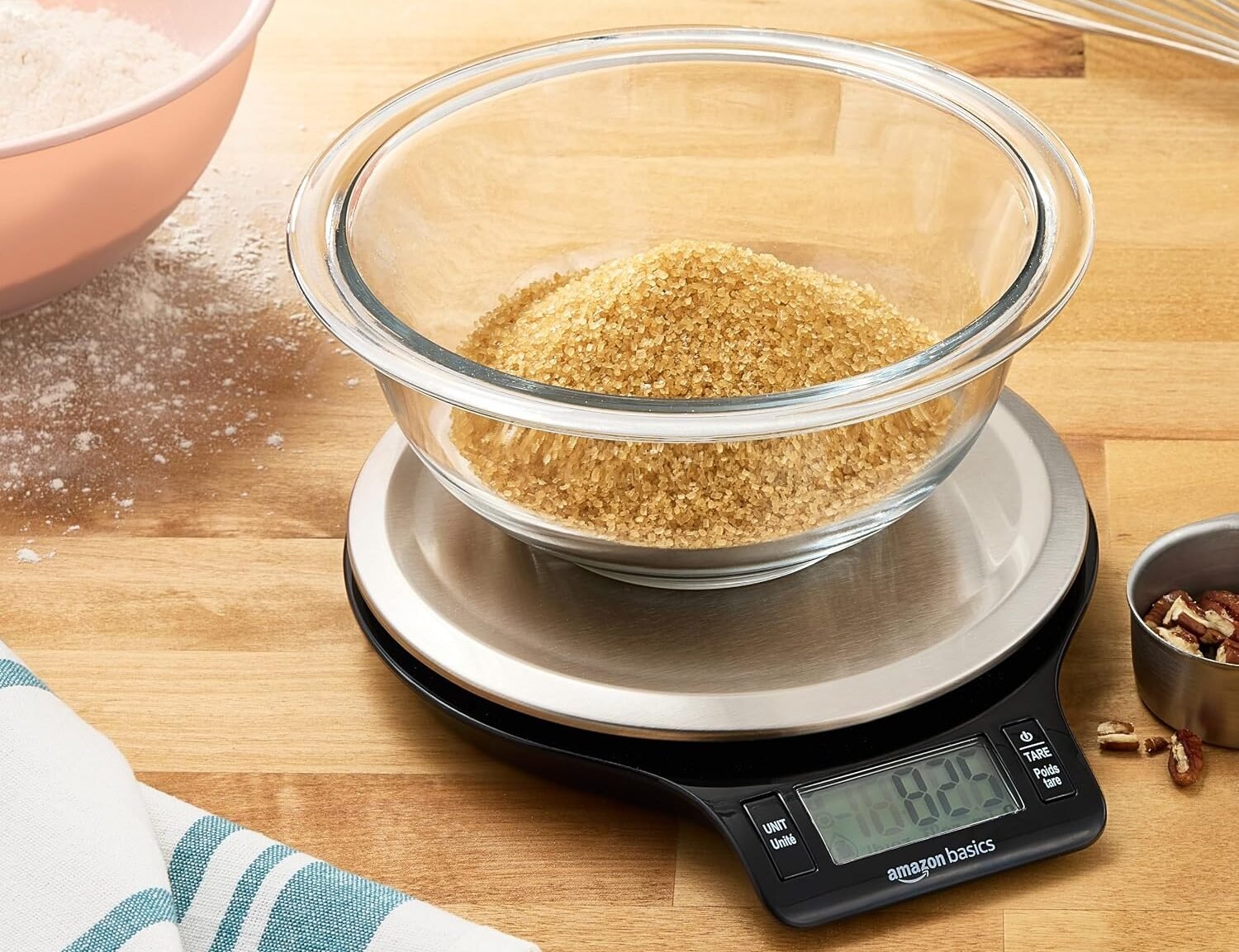
They can also make cleanup surprisingly simple. Instead of using separate measuring containers for several ingredients, you may be able to place a bowl on the scale, reset the displayed weight, add one ingredient, reset again, and continue with the next.

Which brings us to one of the most useful buttons on the entire device.

Quick Tip

Look for a scale with an easy-to-use tare function. Tare lets you place an empty bowl or container on the platform and reset the display to zero. You can then measure the ingredient without manually subtracting the weight of the container.

When adding several ingredients to one bowl, you can often tare between additions. Just make sure the combined weight of the bowl and ingredients remains within the scale manufacturer’s stated capacity.

Don't wait! Get Best Deals NOW!

Are you looking for the best prices on the products you love? Then you don't want to miss this opportunity. . Hurry, these deals won't last long. DON'T WAIT! GET BEST DEALS NOW!

What Actually Matters When You’re Choosing a Digital Kitchen Scale?

Kitchen scales can look remarkably similar online. A flat platform, a small display, a couple of buttons—how different could they really be?

Quite different, actually.

Start with maximum capacity. A compact scale may be perfectly adequate for ordinary recipe ingredients, but remember that the scale supports the container as well as its contents. A heavy mixing bowl consumes part of the available capacity before you add a single ingredient.

Then look at measurement increments or resolution. Depending on the model, a scale might display weight in increments of 1 gram or use another specified resolution. If you regularly measure very small quantities, check whether the particular scale is designed for the level of measurement you need.

Units matter as well. Many digital kitchen scales can switch between grams and ounces, while some offer additional measurement modes. Don’t assume a particular unit is available—verify it in the specifications.

Other features worth considering include:

  • Tare function for excluding container weight
  • Readable display that isn’t hidden by larger bowls
  • Suitable platform size for your usual containers
  • Automatic shutoff where available
  • Low-battery indication on compatible models
  • Easy-clean surface for everyday kitchen use
  • Appropriate measurement units for the recipes you follow

Think about storage too. Do you want the scale permanently on the counter, or will it live in a drawer? A slim model can be particularly convenient in a smaller kitchen, but an extremely compact platform may be awkward with oversized bowls.

There is no universally perfect scale. The best design is the one that fits the way you actually cook.

And don’t confuse more features with better performance. If all you need is reliable ingredient weighing, a straightforward scale with a clear display, suitable capacity, and convenient tare function may be far more useful than a complicated model filled with functions you’ll never touch.

How Digital Kitchen Scales Fit Into Everyday Life

The interesting thing about digital kitchen scales is how quickly they can disappear into your routine. At first, you deliberately remember to use the scale. A few weeks later, reaching for it can become as natural as grabbing a cutting board.

Imagine making breakfast. You place a bowl on the platform, tare the scale, add your ingredients, and you’re done. At lunchtime, you use it while preparing several portions in advance. In the evening, a recipe written in grams becomes refreshingly straightforward because there is no need to convert every measurement into cups.

Then there are recipes you want to resize. Need half a batch? Weight-based ingredient quantities can often make the arithmetic considerably cleaner. Doubling a recipe works the same way.

Digital scales can also be useful when consistency matters more than strict recipe following. Perhaps you want hamburger patties of similar size, evenly divided dough portions, or comparable amounts of pasta for several servings. A scale gives you an objective reference instead of relying entirely on your eyes.

Does everything need to be weighed? Of course not.

Cooking should still feel like cooking. There are plenty of moments when a handful, splash, pinch, or taste is exactly the right measurement. A scale isn’t there to remove instinct from the kitchen; it’s there when precision makes the job easier.

This balance is what makes the tool so useful. You can be precise with the flour and spontaneous with the seasoning. Measure the dough portions carefully, then decide the toppings entirely by mood.

Precision and creativity aren’t opposites. In a good kitchen, they often work together.

Disclosure: The links provided above are affiliated. If you make a purchase through these links, I may receive a small commission at no additional cost to you. This helps support our website and allows us to continue providing valuable content on outdoor adventures.

MORE DEALS IN THIS CATEGORY

Before You Buy Digital Kitchen Scales, Check the Details

If you’re browsing digital kitchen scales through an online marketplace or auction, don’t choose by appearance alone. Read the actual product listing.

Check the maximum capacity, measurement resolution, supported units, platform dimensions, power source, included accessories, and operating instructions. If batteries are required, determine whether they’re included or need to be purchased separately.

Condition matters too. For an auction item, confirm whether the scale is new, open-package, returned, or used. Look carefully at photographs for damage to the platform, display, buttons, battery compartment, or housing.

For a used scale, you’ll also want confidence that it operates correctly. If the seller provides testing information, review exactly what was tested rather than assuming full functionality from a general description.

Finally, think about the total price. A low bid can be appealing, but any buyer’s premium, shipping charge, or collection expense should be considered when deciding how much the scale is actually worth to you.

Once you’ve found the right model, using it is wonderfully uncomplicated. Put it somewhere accessible. Learn the tare button. Keep the weighing surface clean according to the manufacturer’s instructions. Avoid exceeding its stated capacity.

Then cook.

That’s ultimately why digital kitchen scales deserve space in so many kitchens. They don’t demand that you become a professional baker or turn every dinner into a scientific experiment. They simply give you a more consistent way to measure when consistency matters.

And for such a small piece of kitchen equipment, that’s a remarkably useful job.

Browse our current auction listings, compare available digital kitchen scales, and bid on the model whose capacity, features, condition, and price make sense for your kitchen.

No Comments

Sorry, the comment form is closed at this time.